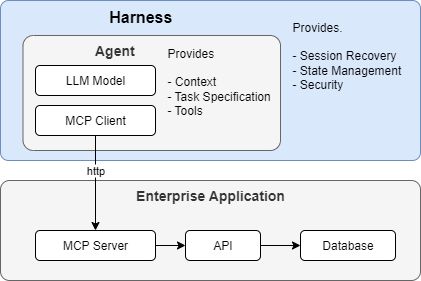
How can Enterprise incorporates AI Models into its business processes beyond Claude Desktop or Microsoft Co-pilot? This article shares the architecture of how LLM can be integrated with enterprise applications.

啥的啥
Saturday, August 22, 2026 at 05:00 PM
When I ask around do you use AI in your work, most would share how successful they are in using Co-pilot in Office 365 applications or using Claude Desktop to do single maybe repetitive tasks. The greatest challenge with these usage is the AI Model is disconnected from Enterprise. In order for Enterprise to benefit from AI Model reasoning capability, company employees would have to upload information or static documents for the AI Model to have better context of the tasks.
Are we restricted to such disconnected usage of LLM Model? No. LLM Model can be wired up to real-time enterprise data. Giving real-time operational data to LLM Model unlocks immerse operational productivity possibility.
The diagram below shows a solution architecture that could be deployed in an enterprise to integrate LLM Model with Enterprise Applications to leverage on agentic capability for every day work.
The most dominating AI Models are Large Language Models or LLMs. All of human's knowledge is written in words; codes are structured syntax of words in fixed sequence and format. These models are trained with large amount of general knowledge literatures and codes. They can take in large input tokens and can hold large context tokens in memory to perform complex layered tasks with multiple processing sequences.
Some may call AI Models stochastics parrot, which is correct to some extend, as LLM use its trained data to predicts and output the next response word to form the entire response. One major difference between LLM and Human Beings is LLM runs on computers. They would get not tired and they do not have emotion.
LLM captures and can reproduce the human intelligence based on the information it is trained on and layers of reasoning and feedback to provide prompt responses continuously.
Model Context Protocol is a integration protocol for LLM Models. Anthropic describes it as akin to USB ports for LLM Models. LLM provides the prompt understanding and reasoning capability within the knowledge bound of the data used to train the Model. MCP Server provides tools to LLM Model. Tools are like hands and legs to the LLM Models. Each tool provides LLM Models with a specific capability to fetch external data or trigger a action beyond trained literatures. LLM Model can activate tools base on user prompt automatically.
With Tools, enterprise could tap on the capability of LLM Models for internal processes.
Anthropic developed Model Context Protocol to allow LLM Models to discover tools and use them to fulfill user prompts.
MCP Tool can leverage on existing application APIs to provide real-time data fetch or perform action.